
Why Uncertainty Leads to Repetition, Not Adaptation
Why do people double down on existing approaches even when the environment clearly changes?
I have been thinking about this in the context of the deteriorating federal research funding environment.
In 2025, the National Institutes of Health (NIH) cut the number of new awards and frequently shifted grant-making policy and rules. This has generated unprecedented turbulence, resulted in funding shortfalls, and made longer-term planning nearly impossible. Yet I suspect many are responding to the turbulent environment not by diversifying portfolios, but by submitting MORE proposals to the same federal funders.
This behavior is non-optimal, but psychology shows it is a very predictable response to uncertainty.
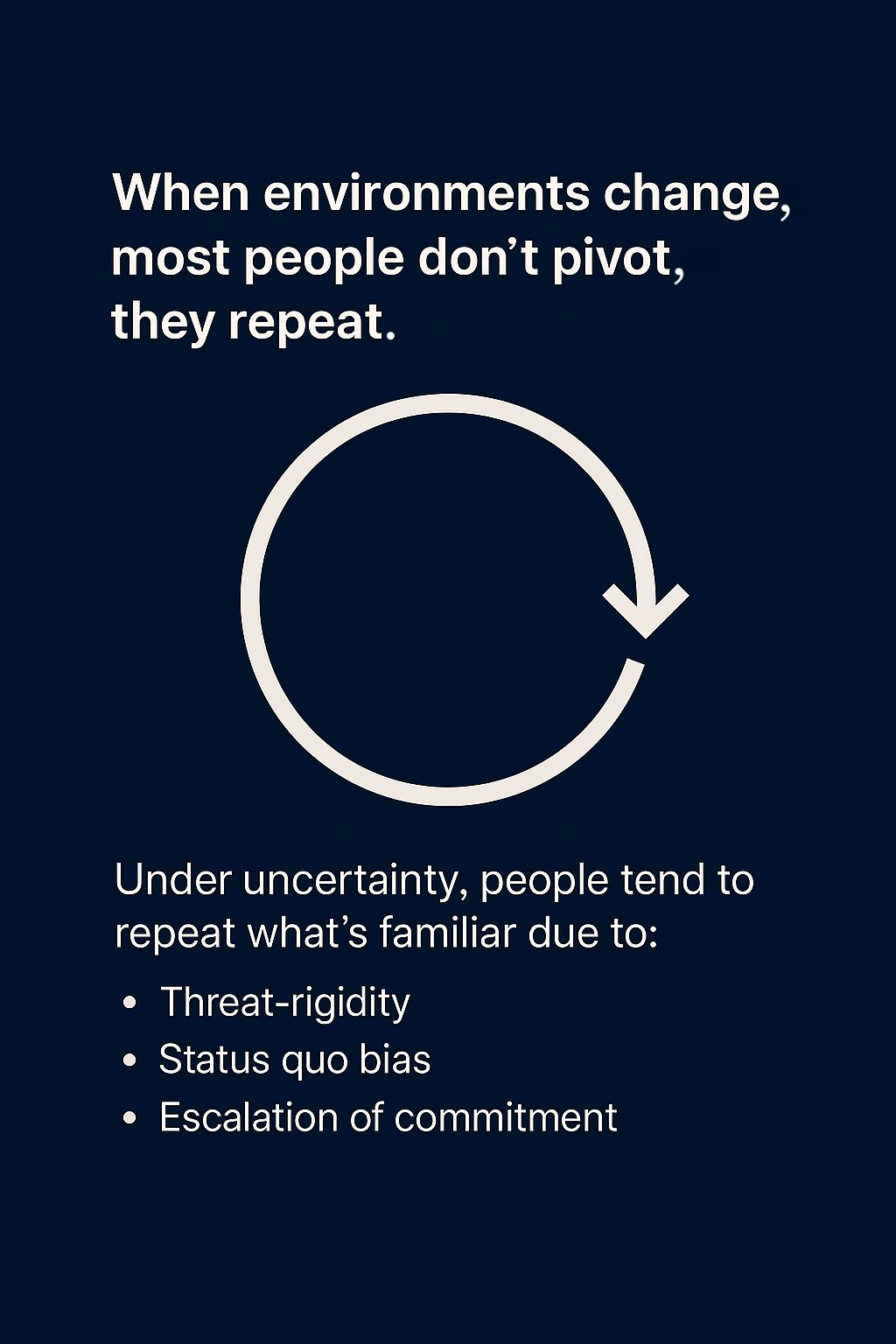
Three Mechanisms Behind the Repetition Response
Three well-established mechanisms help explain why uncertainty often leads to repetition instead of adaptation:
1. Threat-Rigidity (Staw, Sandelands and Dutton)
Under pressure, people and organizations narrow their search, reduce experimentation, and fall back on familiar routines.
2. Status Quo Bias (Kahneman and Tversky)
When outcomes feel uncertain, the familiar path feels safer than exploring alternatives, even when the environment is clearly shifting.
3. Escalation of Commitment (Staw)
Explained by the sunk cost fallacy: past effort makes people more likely to continue investing, even when evidence suggests they should pivot.
The Structural Implication
There is also an important structural implication worth noting. If many investigators and departments respond to deteriorating federal budgets by increasing submissions to the same federal funders, competition tightens even more.
In other words, collective behavior amplifies the very pressures that triggered it.
The Bottom Line
Taken together, these dynamics help explain why a worsening environment does not naturally produce a new research funding strategy. It is more likely to produce more of the same, even when diversification and exploration would be the rational and more productive approach.
I am curious to hear what research leaders are seeing at their institutions. Feel free to to share your perspective.