
A $356 Million Field Meets a Generation of Fortunes
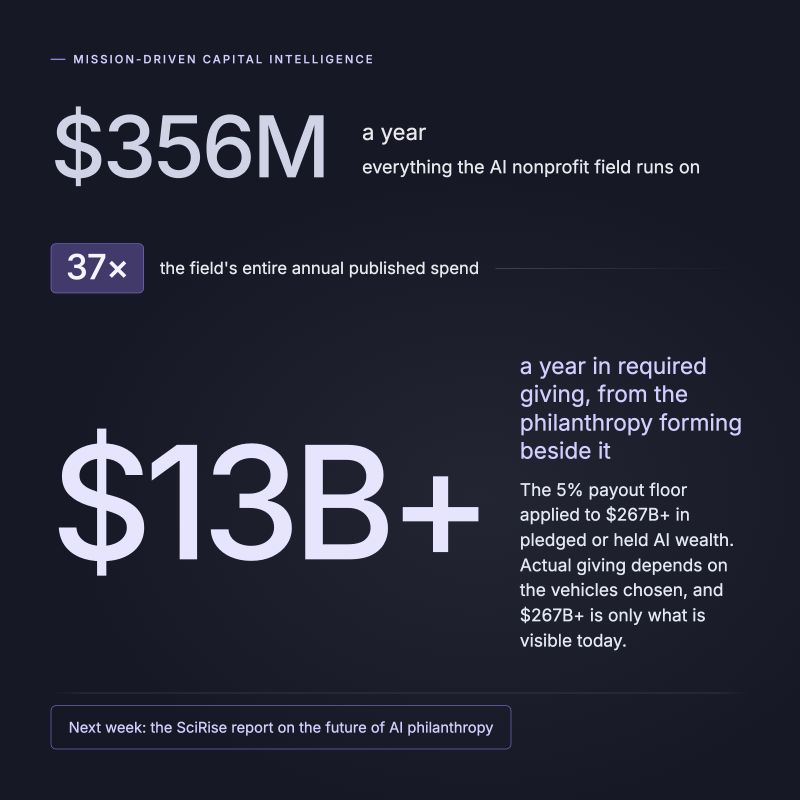
The AI nonprofit field is forming just ahead of one of the largest private-wealth creation events philanthropy has ever seen.
In 2024, 74 foundations wrote 216 identifiable AI-purpose grants totaling $143.3 million. The dedicated AI nonprofit field itself spends about $356 million a year.
Now look at what is forming around it.
The OpenAI Foundation holds an equity stake in OpenAI Group worth more than $180 billion and has made an initial $25 billion commitment, with no stated deployment timeline.
Its 2024 filing showed just $7.6 million in grants.
Since then, the scale has changed almost beyond comparison. OpenAI now says the Foundation expects to invest at least $1 billion over the coming year.
Much of its largest early grantmaking went to universities, including Superalignment research grants to Carnegie Mellon, Berkeley, Stanford, Harvard and Princeton.
And OpenAI is not the story. It is the first visible instance of one.
Earlier this year, all seven Anthropic cofounders pledged to give 80 percent of their wealth to philanthropy. Forbes now estimates the value represented by that pledge at nearly $87 billion, although most of that wealth remains tied up in a private company.
The deployment infrastructure is forming alongside it. RAISE US brings together OpenAI, Anthropic, Microsoft, Amazon and others around AI-era workforce transition. NextLadder is a $1 billion, fifteen-year initiative co-founded by the Gates Foundation and four other major philanthropies, with Anthropic as its inaugural AI partner.
We have seen extreme philanthropic concentration reshape a field before.
Our analysis puts the Gates Foundation at roughly three-quarters of U.S. foundation global-health giving, consistent with independent estimates from Candid and the Council on Foundations.
In 1999, Gates made an initial $750 million commitment that provided seed capital to launch Gavi in 2000.
At that scale, philanthropy can do more than fund the institutions that already exist. It can help create new ones.
The question is no longer just what happens when one mega-funder meets a small field.
It is what happens when a $350 million field meets a generation of fortunes.
Stay tuned for a SciRise report on the future of AI philanthropy next week.
Source: SciRise Mission-Driven Capital Intelligence Dataset. SciRise is an independent venture and is not affiliated with, sponsored by, or endorsed by Duke University.